
Account Warming
A 30-day, five-phase aging program that builds each Gmail account's reputation through human-paced browser activity before any syndication touches it.
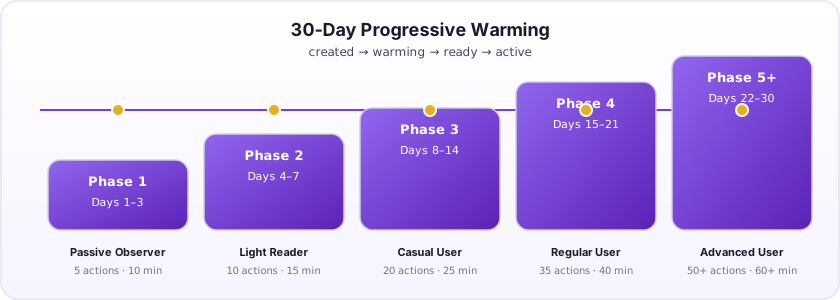
Warming is the bridge between a freshly imported Gmail account and an account that is safe to syndicate from. Rather than logging in and immediately posting, Sola Merlino drives each identity through realistic, escalating browser behaviour — reading mail, searching, watching videos, idling — so that the account accrues a natural activity history. Every action runs through the same warmed browser identity (stable fingerprint, assigned proxy region, human cadence) that will later carry syndication, and content only flows once the account's aging stage allows it.
Warming never manipulates content or platforms. It establishes a consistent fingerprint, a bound proxy, and a human activity cadence so the account reads as a real person over time. Legitimate reputation building, not evasion of policy.
The 30-day progression
Each account advances through five phases over 30 days. As the account matures, the warming engine raises the maximum number of actions per cycle and lengthens the maximum session, shifting the behavioural profile from a passive observer toward an advanced, fully active user.
| Phase | Days | Name | Max actions | Max session | Behaviour |
|---|---|---|---|---|---|
| P1 | 1–3 | Passive Observer | 5 / 10 min | 10 min | Minimal footprint — opens the inbox, glances at mail, leaves. |
| P2 | 4–7 | Light Reader | 10 / 15 min | 15 min | Reads more email, marks messages, light navigation. |
| P3 | 8–14 | Casual User | 20 / 25 min | 25 min | Broader activity — search, stars, drafts, occasional browsing. |
| P4 | 15–21 | Regular User | 35 / 40 min | 40 min | Sustained, varied use across Gmail and the wider web. |
| P5+ | 22–30 | Advanced User | 50+ / 60+ min | 60+ min | Full active-user profile — long, diverse sessions across services. |
A brand-new account that suddenly performs heavy activity is itself a fraud signal. The graduated curve mirrors how a real person settles into a new mailbox: cautious at first, then steadily more engaged.
Task types
The engine draws from roughly 19 task types, weighting them by phase. Early phases lean on passive reading tasks; later phases unlock composing, sending, and richer cross-service browsing.
Execution pipeline
On every cycle the warming engine selects due tasks, screens account health, and runs the work through the antidetect browser fleet, recording the outcome and feeding it back into each account's reputation.
Schedule due tasks
The scheduler resolves which warming tasks are due for each account based on its current phase, last-run timestamps, and per-phase action limits.
Quarantine check
Accounts flagged unhealthy or quarantined are skipped before any browser is allocated, so problem identities never consume the pool.
Allocate to browser pool
Eligible tasks are assigned to the browser pool, which runs 50+ concurrent sessions, each pinned to its account's profile and proxy.
Execute with CDP evasion + fingerprint coherence
Tasks run through CDP evasion and a coherent fingerprint so the session looks like the same consistent human across every visit.
Record success/fail + adaptive retry
Each task's result is recorded; failures trigger adaptive retry logic rather than blindly hammering the same action.
Update health score
Outcomes roll up into the account's health score, which governs whether it keeps warming, gets quarantined, or graduates.
Log analytics
Every run is logged for analytics, giving operators visibility into progress, throughput, and failure patterns across the fleet.
Health & quarantine
Reputation scoring runs continuously alongside warming. The health score aggregates task outcomes and behavioural signals into one of three account states.
Healthy — passing checks and progressing through its phases normally; eligible for scheduling. Quarantined — temporarily held out of the pool after warning signals, pending recovery, so it can't drag down the fleet or expose itself. Burned — beyond recovery and retired from active use. Reputation scoring decides these transitions automatically from the rolling success/fail history and health updates fed back at the end of each execution cycle.
Pulling a wobbling account out of rotation early protects both that identity and the rest of the pool. A quarantined account stops accruing risk until its signals recover.
Triggering warming
Warming can be started for a single account, a whole batch, or driven from the warmup runner endpoints. In desktop mode a local admin is auto-injected, so no login is required to call these locally.
Related runner endpoints include /warmup/execute-now, /warmup/queue, /warmup/active-browsers, and /warmup/pool-stats for on-demand runs and live pool inspection, plus /api/warmup/stats for aggregate metrics.
Once an account clears its phases and reaches a ready state, it can graduate into a syndication persona and start carrying real, source-grounded content from the Universal Writer.
Sola Merlino · social syndication + account automation · documentation generated 2026-06-27